Baran Yardimci
L3 Extended Diploma in Music Performance and Production
Primary Research:
Quantitative:
For my primary quantitative research, I created an online form and posted it to my social media for people to fill out, all the answers were multiple choice to maintain numerical quantitative data. I will list the results of the form below and explain what this means for my research going forward and what valuable information this tells me. The form got 43 responses and this is how they split.
Q1:

Yes: 39
No: 4
These answers tell me that the majority of the people I interact with both in person and online are informed on grunge which will make the answers on this form 2 conflicting things. 1st is a slight sense of bias, from people who perhaps assume they know everything about the genre and 2nd is that the answers will be informed as they are from people who take an active, participating knowledge in the genre.
Q2:

Yes: 38
No: 5
These results already delve deep into my biggest question of this research task, was grunge ever really a genre? This clearly shows that the majority of people that are knowledgable about grunge (assuming that 4 of the 5 who answered no were the same ones that answered no in Q1) can identify differences as they have answered being able to differentiate between the other sub genres that exist out there.
Q3:

Yes: 38
No: 5
With the same split in opinion as Q2, this question also serves a vey similar role to that one, in the sense that it shows that grunge was independent enough (either as a genre or the product of its times) to alter the way they choose to present themselves to other or even their thoughts if t has affected their politics or general attitude towards life. This means, similar to a lot of other alt subgenres, it at least has it's own ideology, which is both a building block for a scene and a genre.
Q4:

Similar: 3
Some differences: 19
Very different: 20
This is where the answers start getting very interesting as this answer split is very different from the split we got from from the previous 3 questions and it the focus of the question is where the debate really starts heating up, musicality. The musical differences of the biggest grunge bands is what leads many to come to the conclusion that grunge is not a defined musical genre. As we can see only a slither of my sample size for this form answered that the biggest grunge bands have a similar sound musically, with a majority actually pining for the differences of the band, in-fact the most selected option was 'very different'. With the majority of this sample size being supposedly 'knowledgable about grunge' (from previous questions data) this shows there is real credibility in the statement that grunge doesn't have a distinct sound, therefore should it really be musically listed as a genre and will we ever find a correct nomenclature for the 90s music phenomenon.
Q5:
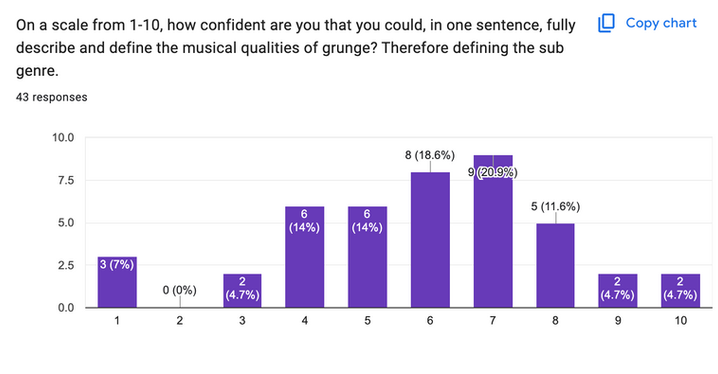
The range of answers within this question proves the point that there is such a diverse opinion on the definition of grunge, meaning that there is no fixed way to define it, 4-8 being the middle range that was picked the most. the fact that more people chose 1 than people who chose 10 also supports this hypothesis. This question in some form does come back for my primary qualitative research, but for now it opens up even more debate on my chosen topic.
Q6:

This again, reinforces the point that despite the fact that there is so much discussion and debate around what grunge really is, whatever it is has clearly had a strong impact on the alternative community (the main demographic for the genre supposedly). Narrowing down this effect can effectively narrow down what grunge is.
Q7:

Through the large selection of bands I chose to be included in this question, I thought that the answer would be narrowed down fairly easily as I could pick up on the distinctive sounds of each of the most popular answers from this form. However this question made the answer even more complicated. With Q4 showing that there is a strong opinion from grunge fans that the 'Big 5' of grunge sound very different from each-other, further reinstating the musical ambiguity of grunge, I thought that the big 5 wouldn't necessarily be the top 5 of this from but I was wrong. These bands being the top selection with the obvious subjectivity of opinionated difference in their sound has made the lean towards grunge being about influence and boundaries (something that all those bands shared) and not necessarily a collective sound. Other bands outside the big 5 who recieved a lot of votes include; Hole, for their ideology, harsh sound and Courtney Love's relation to Kurt Cobain of Nirvana, Mudhoney, probably for their crucial role in the early stages of grunge, The Smashing Pumpkins presumably for their sloppy guitar writing reminiscent of grunge and their continued presence and influential nature in the 90s alt rock scene adjacent to grunge and Temple of the Dog, despite their admittedly softer sound comparatively to the rest of these groups, for it's members being a collected supergroup of grunge all stars as well as the subject matter of the band being grunge's Andrew Wood's death. The collective quality of all these bands is their guitar writing being very heavy and intentionally sloppy which will be a focus in my essay on this topic. The bands selected the least gives me a good idea of what definitely isn't grunge, these include; Husker Du, for their more punky sound and preceding the golden age of grunge, Squirrel Bait for their lack of influence on the scene and also coming before the times of grunge in its peak, The Jins for the opposite reason of coming far after not only the grunge scene but also the post grunge boom of the late 90s and early 00s, Send No Flowers for their lack of influence and failure to capitalise on the scene in any significant way. The similarities between all these bands being their lack to embrace the scene when it was at its highest level of popularity. One user even submitted some bands which I had left out, including; Shades apart, Far Side, Kyuss and Fudge Tunnel. I will investigate these bands further but the current similairty i'm noticing is their harsh and abrasive sound.
Qualitative:
For my primary qualitative research, I created an online form and posted it to my social media for people to fill out, all the answers were text based aside from the demographic questions to keep my datas opinion based and freeform qualitative. I will list the results of the form below and explain what this means for my research going forward and what valuable information this tells me. The form got 15 responses and this is how they split.
Q1:

10-13: 0
14-16: 1
17-20: 12
21-30: 0
31-50: 1
51-64: 1
65+: 0
This question was just to gauge what the demographic of these answers are to further inform me on the actual qualitative based questions. This demographic will be similar to my own (I am 17) as it is a sample size from the people that I interact with online, it also helps show that grunge still has an influence on my generation with the majority answer being 17-20.
Q2:

Male: 10
Female: 3
Prefer not to say: 1
Other: 1
This again is another demographic question, this time with the purpose of figuring out whether grunge really is male dominated and it seems it is. This is further reinstated with the fact that 'Female grunge' even has its own separate label, 'Kinderwhore'.
Q3:

Genre: 7
Time and Place: 2
Other: 6
This question helps settle all the confusion that earlier questions in both forms have done by contradicting what grunge means, the most selected item being genre shows us that grunge fans really do feel a sense of distinctness about the genre. The answers that really took me were the labelled 'Other' options with users helping form different interpretations of grunge. One of these being 'It's a helpful label, music or otherwise. Grunge is no different than say, shoegaze.' this helps support the hypothesis that the label of grunge was just a marketing ploy of the 90s to capitalise on the guitar music coming out of Seattle. Everyone else in the other section responded with grunge being a mix of the 2 different answers I had given automatically. These answers will be used heavily in my essay.
Q4:

As we get into the fully qualitative questions I will only be discussing the answers that particularly strike me. A common recurring theme within the answers seemed to be that true 'grunge' was truly of its time, one user wrote 'Definitely a 90s alternative thing for the people who didn't associate with the standards of music at the time' as well as another saying 'Grunge was used as a descriptive term on mid 80s to describe bands like green river before the spike in popularity the early nineties' as well as many other similar remarks. Another answer which helped blend together a couple others was 'All grunge bands aren't musically similar outside of basic aspects - e.g. distorted guitars and harsh vocals' This seemed to be a common theme which helps show that grunge is hard to categorise and contain musically because of the clear objective differences in sound each group had.
Q5:

This question has helped me understand the lasting effect grunge has had in order to widdle down its identity further, there were some common themes in the answers. A lot of people said they didn't feel alternative but consumed media with that name-tag, for example 'I don’t but I love grunge music especially the early grunge bands like alice in chains, pearl jam and soundgarden, and stone temple pilots' and 'I don’t think of myself as alternative but I do enjoy music and comedy labelled as such'. By far and away the most lasting effect of the grunge scene has clearly been the clothing, with numerous responses in the form discussing the clothing option of baggy jeans and just generally loose fitting clothes, this matches the ideology of grunge of being lazy and tired regarding the status quo of northern American societal norms of the 90s, this ideology has clearly lived on through fashion to this day. Other popular answers included grunge being a gateway to more sub alternative communities, this is probably due to the fact that grunge is one of the only alternative sub genres to have hit it big in the mainstream (thanks to Nirvana's 'Nevermind' in '91) and therefore was a gateway drug to many people into cultures similar to grunge, it clearly still serves that function in the current day. The other variations of answers I received were being able to socialise with others with similar values of grunge with one user even saying, 'I feel like ideology is what makes me alternative and I'd argue grunge ideology is shared across the vast majority of alternative subcultures' thisn implies that grunge is very adjacent to other alternative schools of thought, almost indistinguishable. All these answers will really help inform my definition of grunge.
Q6:

This question serves a similar purpose as compared to question 7 of my quantitative form. Figuring out which grunge band truly represents the movement. The most popular answer was Alice In Chains and the majority of answers discussing them talked about their rough but genius composition and how it has an emotional effect on the listener, this was emphasised with the answer 'Alice in chains, not a niche grunge listener but a friend introduced me during a tough time and i’ve just kept listening to them despite dropping others like them', this shows that grunge is an all time outlet for pent up emotions, still today as it was in the scenes peak. A lot of the answers also discuss the gritty and heavy side of grunge as being their favourable pick, this further reinforces that a staple of grunge was its unforgiving nature to not be clean cut which seeps through the fashion and ideology of the scene. These answers will really help inform my definition of the musical qualities of grunge going forward.
Q7:

As you can imagine, the most popular discussion within the answers to this question were the undeniable raspy vocals and guitar distortion. Users submitting answers such as 'Raspy voice that comes from the soul', 'They all have similar raspy vocal styles as well as kinda heavy guitar tone' and 'guitar distortion?', this both helps and steers of course because yes, these are all common characteristics but these are all too common for alt rock in general and make it hard to narrow down what makes grunge different musically from their contemporaries. One user mentioned the fusion of punk and metal aspects which helped to create the sound, this will be a focal talking point in my essay and helps to show the formation of grunge and how it advanced from this form. Another user spoke about the fashion, further implying that the ideology and aesthetic of grunge takes the forefront over distinctive musical qualities.
Q8:

Touch Me I'm Sick: 6
Green River: 4
Squirrel Bait: 0
Andrew Wood: 1
Nevermind: 1
Deep Six: 0
Other: 1
These answers help me show the formation of grunge in my essay to help narrow down its identity. The most popular answer being mudhoney as they were the first grunge band to hit charted territory and be nationally noticed. Others point to Green River as they were an earlier version of Mudhoney but never made anything particularly influential or made any significant impact. Some even believe it was as late as the release of 'Nevermind' in 1991 which is when grunge become known worldwide, this is maybe due to the accepting and tolerant nature of grunge ideology and the belief that it can only be enjoyed by everyone if it is to be enjoyed at all. This discourse into the birth of grunge can help me understand the effects of its formation in Seattle.
Q7:


Kurt Cobain: 1
Bush: 0
AIC Unplugged: 1
Layne Stayley: 2
Soundgarden: 2
Post Grunge: 3
Not Dead: 2
Other: 4
These answers help me show the end of grunge in my essay to help narrow down its identity. The most popular answer (Out of my selected options) being the rise of post grunge into the mainstream, this was a hallmark as something else was taking the throne that grunge has so confidently held for years, this fall from grace meant the scene never properly recovered. 2 users believe that grunge isn't dead and has more been 'Mortally Wounded' and won't recover and be in the spotlight again which is a genuine argument and goes further to prove that maybe grunge is just an ideology rather than a music genre. Most the 'other' answers also discuss this, with one talking about the rise of pop punk instead. Whatever the follow up to grunge was, it was definitely unrevivable by '97 and this will be crucial in my essay. This discourse into the death of grunge can help me understand the effects of its end and its repercussions.